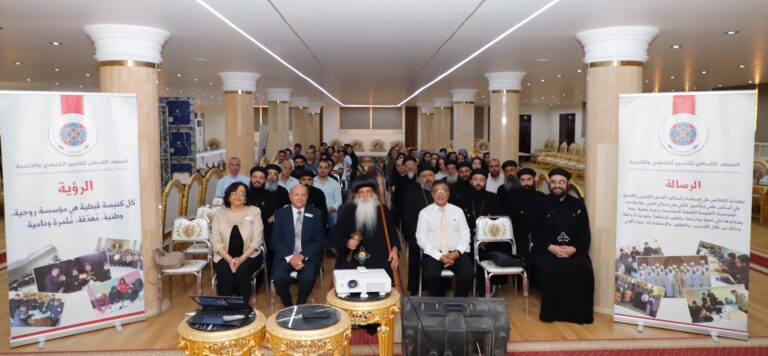
His Grace Bishop Julius’ meeting with the Dean of the Institute as part of the interim evaluation of the Integrated Community Development Program.
On Monday, May 11, 2020, His Grace Bishop Julius, Bishop of Public and Social Services and General Bishop of the Churches of Old Cairo, received Dr. Magdy Latif Al-Sindi, Dean of the Coptic Institute for Church Management and Development, and members of the Institute’s Development Unit team. The following were present:
Prof. Ghada Barsoum and Prof. Iman Nasri. This was within the framework of discussing the results of the interim evaluation conducted by the Institute for the Integrated Community Development Program.
The Integrated Community Development Program (ICDP). The diocese has been implementing this program since 2018 in 45 villages and communities across the governorates of the Arab Republic of Egypt.
The recommendations from the evaluation report were presented and discussed in the presence of His Grace Anba Youlios, Dr. Hany Samir, the Executive Director of the Bishopric, and some of the Bishopric’s technical program leaders. The “Integrated Community Development Program” includes four main pillars, each containing a set of technical interventions. This program was designed using a scientific methodology to encompass a number of developmental activities operating within the context of rural and informal communities (such as education, health, income generation, capacity building, youth care, community peacebuilding, etc.).
The Institute’s evaluation team employed both qualitative and quantitative research methodologies and relied on the following evaluation criteria: relevance, effectiveness, efficiency, and sustainability. The evaluation also included a review of program documents, field visits, and structured interviews with program leaders and implementers. The report commended the Bishopric’s efforts in designing and implementing the program, which came as an extension of the Bishopric’s experience from previous programs. The report also outlined the lessons learned and proposed recommendations for the program’s next phase.